
Carrington Precinct Project
Project Overview
The Carrington Precinct Project (the Project) involves updating and combining existing planning approvals, along with targeted upgrades within an established operational area at Port of Newcastle.
The Project aims to support the diversification of trade, address ageing infrastructure, and improve the Port’s long-term operational efficiency and resilience.
The proposed upgrades include the construction of new hardstand areas for general cargo storage, marine works at the Channel Berth, and upgrades to the Port’s high and low voltage electrical infrastructure.
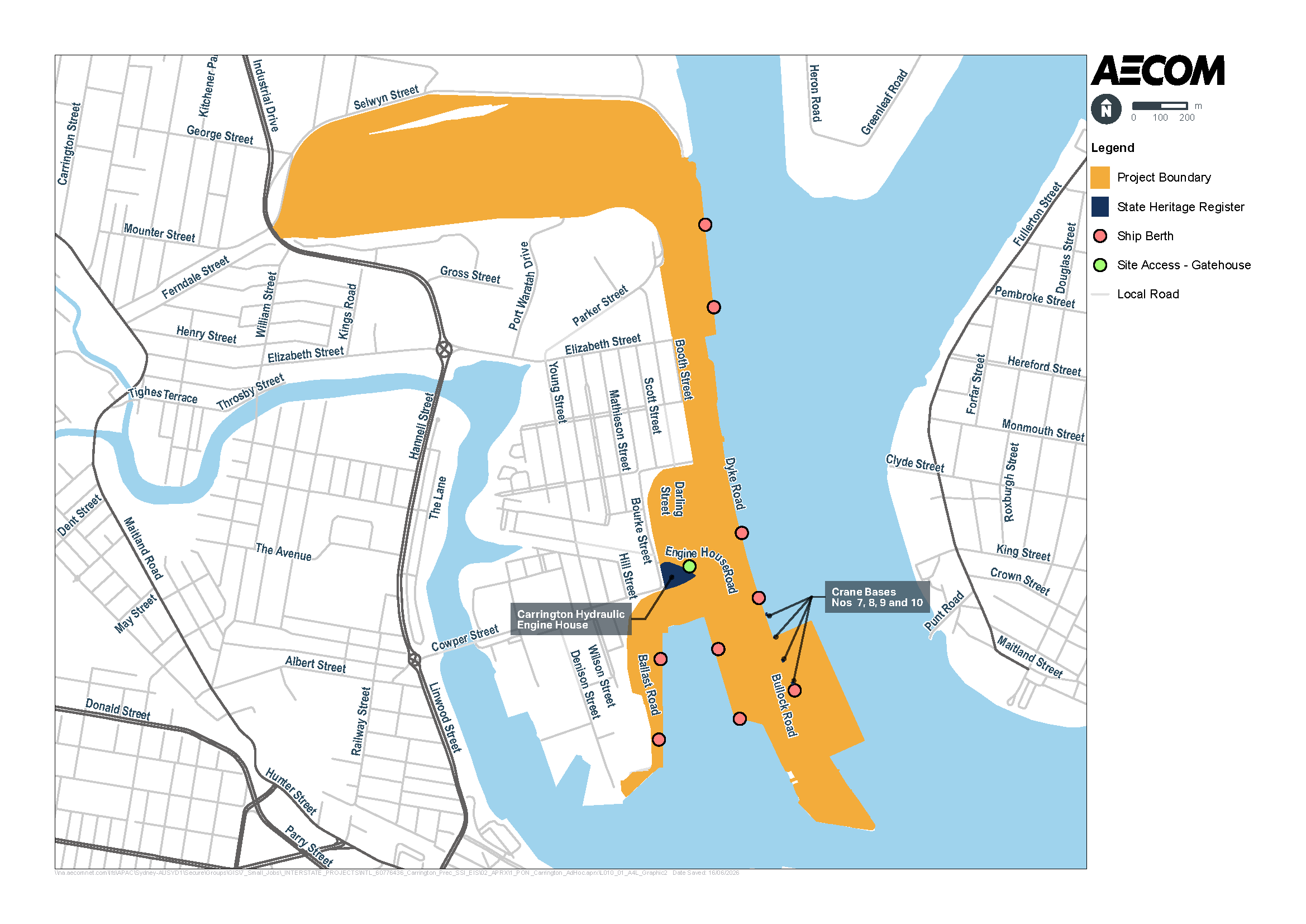
The Project aligns with the objectives of the Port of Newcastle Development Plan 2023–2028 and other relevant strategic planning policies, including:
- Future Transport Strategy 2056;
- State Infrastructure Strategy 2022-2042;
- NSW Trade and Investment Strategy 2035;
- NSW Industry Policy;
- Hunter Regional Plan 2041;
- Greater Newcastle Metropolitan Plan 2036; and
- Newcastle Local Strategic Planning Statement.
Port of Newcastle is seeking planning approval for the Project through the State Significant Infrastructure (SSI) pathway under Division 5.2 of the Environmental Planning and Assessment Act 1979.
The Port is preparing and will submit a Scoping Report to help determine the Secretary’s Environmental Assessment Requirements (SEARs). The SEARs will then guide the preparation of the Environmental Impact Statement (EIS).
Further Information
For more information contact Port of Newcastle via [email protected] or call (02) 02 4908 288.
Planning & Approvals
For current information on planning and approvals visit Planning Framework and Approvals.
FAQs
What is the Carrington Precinct?
The Carrington Precinct is a well-established area within the Port of Newcastle, located on the southern side of the Hunter River at Carrington. It covers about 135 hectares of working port land stretching from Selwyn Street at Mayfield to Dyke Point. It is bordered by the Hunter River to the east and industrial port land along Darling Street, Bourke Street and Denison Street to the west. As defined in the Port Development Plan 2023-2028, the Carrington Precinct includes four main areas: the General Cargo Precinct, Marine Precinct, Energy Precinct and Bulk Precinct.
What is the General Cargo Precinct?
The General Cargo Precinct is part of the Carrington Precinct, as defined by the Port Development Plan 2023-2028. It is mainly used for handling, storing and moving general cargo. The area includes the land and water around Western Basin 3 and 4, Eastern Basin 1 and 2, and the Channel Berth, along with nearby hardstand areas, internal port roads, and supporting infrastructure.
What type of cargo does the Carrington Precinct currently handle?
The Carrington Precinct operates 24 hours a day and handles a wide range of cargo. This includes steel and aluminium, timber, machinery and mining equipment, oversized project cargo, containers, and vehicles (including roll-on/roll-off cargo). It also handles agricultural and specialised goods, such as luxury yachts.
These activities take place across the Western and Eastern Basins and the Channel Berth. They are supported by existing facilities such as berths, warehouses, hardstand areas, rail sidings and internal roads, allowing goods to be efficiently imported, exported, stored and moved.
Why are targeted upgrades needed for the Carrington Precinct?
The Port of Newcastle (the Port) needs to upgrade the Carrington Precinct to keep it running safely, efficiently and competitively as trade changes. Much of the infrastructure is ageing and becoming less reliable, which limits capacity. Demand for a wider mix of cargo (like general goods, large project items and vehicles) is also increasing and putting pressure on existing facilities.
The upgrades will make better use of existing berths, increase storage and marshalling space, modernise electrical systems, and bring existing development approvals into one updated framework. Overall, this will help the Port handle more diverse trade, improve reliability, and support long-term growth, strengthening the Port’s long-term future and continuing our commitment to supporting the Hunter region for decades to come.
Will the Project change how the Port operates?
No. The Project will not fundamentally change how the Port operates.
It focuses on upgrading existing infrastructure and continuing current activities, not introducing new types of operations. The Carrington Precinct will continue to operate as a 24-hour general cargo and logistics area, as it does now. The changes will improve efficiency, safety and reliability, and support gradual growth in diversified trade.
Importantly, the Project does not expand the Port beyond its current footprint, introduce new high-risk uses, or change the Port’s overall role in Newcastle. It simply improves existing operations.
Will this impact cruise ships?
No. Port of Newcastle will continue to host cruise ships at Channel Berth during cruise season.
How does the Project benefit Newcastle and the Hunter region?
The Project will support local jobs, economic growth and long-term resilience in Newcastle and the Hunter region by strengthening the Port’s ability to handle a wider range of trade.
Upgrading Channel Berth and new storage areas will help attract new industries and increase logistics activity, supporting local supply chains and employment. It will also improve the reliability of a nationally important Port, helping industries like manufacturing, agriculture, construction and energy diversification projects.
By making better use of existing land and assets, the Port of Newcastle can adapt to changing economic conditions while continuing to support regional growth.
How will Port of Newcastle engage the community and stakeholders?
The Port of Newcastle is committed to ongoing and transparent consultation in line with NSW guidelines for major projects.
We’ve already started engagement, with Project briefings to government agencies, port tenants and community groups underway. We also have a dedicated project page on our website, and an established email address and phone line for enquiries.
We’ll continue our consultation throughout planning and assessment. This will include stakeholder meetings, community updates, public information sessions and opportunities to provide feedback when the Environmental Impact Statement (EIS) is on public exhibition. Feedback will be considered in the project design, and we’ll share updates so our community and stakeholders can see how concerns are being addressed.
Which environmental matters will the Environmental Impact Statement include?
The EIS will assess a range of environmental and social factors to understand and manage potential impacts. This includes traffic, noise, air quality, social impacts, heritage, land and water conditions, biodiversity, hazards, visual impacts, land use, climate change, waste, and cumulative impacts.
The Project will be assessed according to its potential impact, with detailed studies where needed. The EIS will also outline practical steps to avoid or reduce impacts during construction and operation, informed by input from regulators, stakeholders and the community.
When will the EIS be completed?
The project is in the early scoping stage, with the EIS expected to be completed in early 2027.
When will the construction start?
Construction is planned to start in late 2027, subject to approval.
How long will the Project take to build?
Construction of the works will be staged, with completion of all stages expected to take about three years.
